





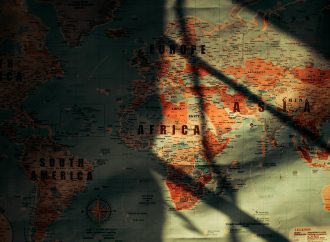
Borders are not just lines on a map. They are fault lines in the global economy — invisible pressure points where political decisions collide with trade flows, currency markets, and corporate strategy. For investors, business leaders, and informed citizens alike, understanding geopolitics is no longer a luxury reserved for diplomats and academics. It is a
Borders are not just lines on a map. They are fault lines in the global economy — invisible pressure points where political decisions collide with trade flows, currency markets, and corporate strategy. For investors, business leaders, and informed citizens alike, understanding geopolitics is no longer a luxury reserved for diplomats and academics. It is a fundamental literacy requirement for navigating the modern world.
This piece explores the enduring relationship between geopolitics and economic outcomes — why it matters, how it works, and what historically has separated nations and markets that thrive from those that falter when the ground shifts beneath them.
What Is Geopolitics, and Why Does It Matter to Markets?
Geopolitics is the study of how geography, power, and international relations intersect to shape the behavior of nations. It examines why countries compete for certain territories, why alliances form and fracture, and how the physical world — oceans, mountain ranges, resource deposits, chokepoints — constrains the choices of governments and armies alike.
For centuries, geopolitics was primarily a strategic military concern. Today, its consequences ripple immediately and forcefully into financial markets. When a major power imposes sanctions on an energy-exporting nation, oil prices move. When a shipping lane in a contested strait faces disruption, the cost of global trade rises overnight. When two dominant economies decouple their technology supply chains, entire industries are forced to restructure.
The core insight is simple: political risk is financial risk. Markets price stability. Instability — whether driven by conflict, sanctions, resource nationalism, or the breakdown of international institutions — introduces uncertainty that investors, corporations, and consumers must all absorb.
The Three Pillars of Geopolitical Risk
Understanding geopolitical risk requires looking at three distinct but interrelated categories.
1. Resource Competition
Natural resources have always been at the heart of great power competition. Oil, natural gas, rare earth minerals, fresh water, and agricultural land are not distributed evenly across the planet. Nations that control critical resources hold outsized leverage over those that depend on them — and history is full of conflicts, alliances, and economic arrangements born of this asymmetry.
The global transition to clean energy has not reduced resource competition; it has redirected it. Lithium, cobalt, nickel, and copper — the materials required for electric vehicle batteries and renewable energy infrastructure — are concentrated in a handful of countries. As demand for these materials accelerates, geopolitical competition over their supply chains is intensifying in ways that will define the next several decades of industrial policy.
For investors, this means that the energy transition is not purely a technological or financial story. It is a geopolitical one. Nations and companies that secure reliable access to critical materials will hold durable competitive advantages. Those that do not may face structural constraints that no amount of capital or innovation can quickly overcome.
2. Trade Architecture and Economic Interdependence
The post-World War II international order was built, in significant part, on a theory: that economic interdependence reduces the likelihood of conflict. If nations trade heavily with one another, the logic goes, the cost of war becomes prohibitively high.
This theory has proved partially correct and partially naive. Economic interdependence does create powerful incentives for cooperation. But it also creates vulnerabilities — and vulnerabilities invite leverage. A nation that depends on a single supplier for a critical input is not insulated from geopolitical pressure; it is exposed to it.
The strategic use of trade as a geopolitical instrument has become increasingly common. Export controls, import tariffs, investment restrictions, and technology transfer bans are all tools that governments deploy not merely for economic reasons, but to shape the strategic balance of power. When major economies use market access as a bargaining chip, every multinational corporation with cross-border supply chains is caught in the crossfire.
Businesses that understand this dynamic build supply chain resilience into their strategic planning — identifying single points of failure, diversifying supplier geographies, and maintaining buffer inventories for inputs that could become weaponized in a political dispute.
3. Alliance Systems and Institutional Stability
Global commerce depends on a web of rules, norms, and institutions — the World Trade Organization, international arbitration courts, bilateral investment treaties, central bank swap lines, and the reserve currency system. These frameworks reduce transaction costs and lower political risk by creating predictable rules of the road.
When institutional frameworks erode — whether through the withdrawal of major powers, deliberate undermining by revisionist states, or simple neglect — the cost of doing business internationally rises. Contracts become harder to enforce. Dispute resolution becomes more political and less predictable. Capital flows to jurisdictions where rule of law remains robust, and away from those where it has frayed.
For this reason, the health of international institutions is not an abstract foreign policy concern. It is a material factor in where investment goes, how supply chains are structured, and what risk premiums are embedded in sovereign debt.
Why Geography Still Governs Strategy
In an age of digital connectivity and instantaneous global communication, it is tempting to believe that geography has been overcome. It has not. Geography constrains logistics, determines military defensibility, shapes energy economics, and defines which nations are natural trading partners and which are natural rivals.
Consider maritime chokepoints: the Strait of Hormuz, the Strait of Malacca, the Suez Canal, and the Taiwan Strait. Roughly 40% of the world’s seaborne trade passes through just a handful of these narrow passages. A disruption at any one of them — whether through conflict, accident, or deliberate blockade — sends shockwaves through commodity markets and insurance premiums within hours.
Or consider the Arctic. As polar ice retreats, new shipping lanes are opening that could dramatically reduce transit times between major economies. Nations with Arctic coastlines — Russia, Canada, the United States, Norway, Denmark — are already engaged in a quiet competition for strategic positioning in a region whose economic and military significance is rising with every passing year.
Geography does not determine destiny. But it sets the strategic agenda that governments and corporations must work within, around, and against.
How Investors and Businesses Can Apply Geopolitical Intelligence
Sophisticated market participants have always incorporated political risk into their analysis. Today, the speed and complexity of geopolitical developments demand a more systematic approach. A few principles stand out.
Scenario planning over prediction. Geopolitical outcomes are rarely certain — but the range of plausible scenarios can be mapped. Businesses and investors who pressure-test their strategies against multiple futures — not just the most likely one — are better positioned to respond when surprises occur.
Distinguish signal from noise. Not every diplomatic incident or political speech has lasting economic consequences. The ability to distinguish genuine structural shifts from transient turbulence is essential. A new trade agreement between major economies represents a structural shift. A heated exchange at a United Nations session typically does not.
Map exposure, not just sentiment. Understanding geopolitical risk requires knowing specifically where your assets, supply chains, counterparties, and revenue streams are exposed to political volatility — not simply having a general view that “the world is uncertain.” Specific exposure maps support specific risk mitigation.
Follow the capital. Where sovereign wealth funds, development banks, and major institutional investors are directing capital often reflects sophisticated geopolitical assessments that are worth tracking. Infrastructure investment in a contested region tells a story about long-term strategic intentions that no diplomatic communiqué will state plainly.
The Enduring Relevance of Geopolitical Thinking
What makes geopolitics a genuinely evergreen discipline is that its underlying drivers — the competition for resources, the pursuit of security, the tension between cooperation and self-interest — are constants of human political organization. Technologies change. Borders shift. Empires rise and fall. But the fundamental logic of nations acting in their perceived interests, constrained by their geography and shaped by their history, remains as relevant as it was in the ancient world.
For anyone operating in the global economy — whether as an investor, executive, policymaker, or informed citizen — ignoring geopolitics is not neutrality. It is simply unpriced risk.
The map of the world is never as stable as it appears on any given day. The investors and institutions that understand why have consistently outperformed those who learned that lesson too late.



















Leave a Comment
Your email address will not be published. Required fields are marked with *